Ask any guide who has spent years on the Bighorn, and they'll tell you the same thing: May is different. May is special.
While most anglers are still planning their summer trips, circling July and August on the calendar and dreaming about pale morning duns and caddis hatches, the people who truly know the Bighorn are already here. They've been here for weeks. And they are not telling anyone.
This is their secret. And now it's yours.
The River in May: What You'll Actually Find
The Bighorn is a tailwater fishery — fed by cold, deep releases from Yellowtail Dam — which means it doesn't behave like most rivers. It doesn't blow out in spring runoff. It doesn't warm too quickly in summer or freeze in winter. It runs clear and cold and consistent in a way that very few rivers in the American West can claim.
In May, water temperatures climb from the low 40s into the high 40s and low 50s — the precise thermal window that turns trout from cold, sluggish winter fish into aggressive, actively feeding predators. This is the moment the river wakes up. And if you're standing on the bank when it happens, you'll never forget it.
Flows in May historically run between 2,000 and 3,000 cubic feet per second — stable, manageable, and ideal for both floating and wade fishing. The water is clear. The fish are visible. And there are a lot of them. The Bighorn holds nearly 2,500 fish per mile at an average of 19 inches or better. On a good May morning you can watch a dozen fish working a single seam.
The Blue Winged Olive Hatch: May's Main Event
If you've never seen a Blue Winged Olive hatch on the Bighorn, put it on your list. It belongs there alongside the great hatches of the fly fishing world.
BWOs emerge throughout the spring, but May is when the hatch truly hits its stride. On overcast, lightly rainy afternoons — the kind of grey Montana days that make everyone else head indoors — the surface of the Bighorn comes alive. Duns appear in the riffles, trout begin to rise, and if you have the right fly on a clean drift, the fishing becomes something close to ridiculous.
The ideal BWO setup is simple: a #14-16 CDC Baetis or parachute pattern on 5X tippet, presented with a drag-free drift into the soft water where the current seams concentrate insects. Target the inside corners of riffles and the tailouts of long flats. That's where the fish stack up when the hatch is on.
On days when the hatch is sparse or the sky clears, don't put the dry fly rod away — just go subsurface. BWO nymphs fished on a two-fly rig just below the surface film will keep your rod bent through the afternoon.
Nymphing: The Foundation of a May Day on the Bighorn
Here's something every serious angler should understand about the Bighorn: sowbugs account for more than half of a resident trout's diet. Not midges, not mayflies — sowbugs. These small crustaceans live in the river bottom in extraordinary numbers, and the fish know exactly where to find them.
A well-presented sowbug nymph is never wrong on the Bighorn. In May it is almost always right.
The most reliable May nymph rig is a two-fly setup anchored by a Soft Hackle Sowbug #16 with a smaller dropper — a Zebra Midge #18-20 or a Pheasant Tail #16-18 works beautifully. Set your indicator to get flies 6-18 inches off the bottom, add enough weight that you're occasionally ticking the riverbed, and focus on making clean, drag-free drifts through soft runs and the deeper buckets where fish are holding.
The key in May is patience. The Bighorn is a technical river. The fish have seen a lot of flies. But get your presentation right — dead drift, proper depth, good tippet — and you will catch fish. A lot of them.
Streamer Fishing: For Those Who Like It Big
May is also one of the finest streamer months on the Bighorn, and it tends to be overlooked by anglers who come for the hatches.
Brown trout outnumber rainbows roughly 3 to 1 on this river, and in May the browns are aggressive. Strip a Thin Mint Woolly Bugger #6 or an Olive Zonker slowly along the banks, through deeper runs, and around any structure that breaks the current. Dead-drift your streamer from the boat and let it swing at the end — some of the biggest fish of the day eat on the swing.
The morning hours before the BWO hatch kicks in are prime streamer time. Work the banks early, then switch to nymphs and dries as the day warms and the hatch begins to build. That combination — streamers in the morning, nymphs midday, dries in the afternoon — makes for one of the most complete days of fly fishing you'll find anywhere.
What May Feels Like
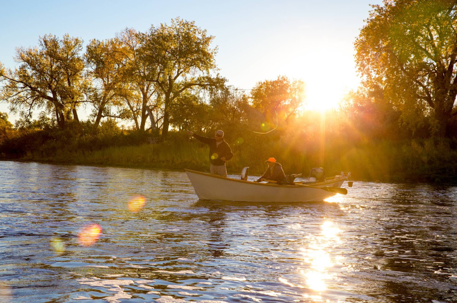
There is an emotional reset that happens in May on the Bighorn. The air is crisp. The Pryor Mountains are still dusted with snow. The cottonwoods along the banks are just beginning to leaf out — that particular shade of spring green that you only see for a few weeks before summer takes over. The meadowlarks are back. The river is impossibly clear.
The pressure of the season hasn't arrived yet. It is just you, your guide, and miles of blue-ribbon water that most of the fly fishing world doesn't even know is fishing this well.
That solitude is not a consolation prize for missing the summer crowds. It is the point.
Forrester's Bighorn River Resort — Fort Smith, Montana. Orvis-endorsed fly fishing since 1992.