
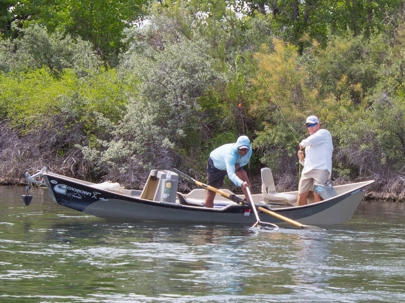
A guide to reading the water, presenting the fly, and landing more fish on one of America's finest tailwaters
The Bighorn River rewards preparation. It is a technical fishery — clear water, educated trout, and currents that demand precision. After decades of guiding on this stretch of river, here is what we know about reading the water and presenting flies the way the fish want to see them.
Read the Micro-Eddies — Where the Big Fish Actually Hide
The most common mistake anglers make on the Bighorn is fishing the obvious water — the fast runs and the classic seams — and wondering why the biggest fish aren't showing up.
Look for tennis-court-sized flats right against the banks where the current reverses. That is where the biggest, most experienced trout set up. They are in the soft water, conserving energy, waiting for food to come to them.
The presentation into these micro-eddies needs to be entirely drag-free. Drop your fly right on the seam where the slow water meets the fast current and let it sit. These fish have seen thousands of flies — they will refuse anything that moves unnaturally, no matter how perfect the pattern.
The Reach Cast — Adding Seconds to Your Drift
On the Bighorn's long, flat runs a standard mend often pulls your fly out of the strike zone before the fish has a chance to commit. The solution is the Reach Cast.
As you finish your forward cast, move your rod tip upstream and parallel to the water before the line hits the surface. This puts a built-in mend into the line the moment it lands, giving you an extra three to four seconds of perfect natural drift. On this river those extra seconds are usually when the magic happens.
Practice this on shorter casts first until the motion feels natural. Once you have it, the Reach Cast becomes your default presentation on the long flats — and your catch rate will show it.
The Two-Second Rule for Heavy Trout
When a big Bighorn fish takes your dry fly the instinct is to set immediately. On this river that instinct will lose you fish.
When you see the take — pause. Count one, two — then smoothly lift the rod. This allows the fish to turn its head down and ensures the hook sets perfectly in the corner of the mouth rather than pulling free. It feels completely wrong the first time. It works every time.
This is especially important during the PMD spinner fall when fish are sipping quietly and the takes are subtle. Slow down your reaction and you will hook significantly more fish.
Solving Micro-Drag — The Silent Killer
As the season progresses and fish see more flies, micro-drag becomes your biggest enemy. Your fly looks like it is drifting perfectly from where you are standing. The fish sees something different — invisible tension on the tippet causing the fly to move ever so slightly against the current.
The fix is simple: drop down a tippet size and add an extra twelve inches of nylon to your leader. The additional slack and suppleness eliminate micro-drag and turn refusals into takes. Going from 4X to 5X, or 5X to 6X, makes a measurable difference during technical dry fly fishing — especially during the PMD and Trico hatches.
Understand the Depth — The Most Important Variable
On the Bighorn depth matters more than pattern selection. A perfect fly at the wrong depth catches nothing. A simple sowbug at the right depth catches fish all day.
Set your indicator so your flies are riding 6 to 18 inches off the bottom depending on the depth of the run. Add weight until you are occasionally ticking the bottom. If you are not ticking bottom — add weight before you change flies. Most anglers change patterns when depth is the real problem.
A two-fly nymph rig with a sowbug or scud on top and a smaller midge or perdigon as a dropper, fished at the correct depth with a clean drift, is the most consistent setup on this river across every season.
Know Your Season — Timing is Everything
The Bighorn fishes year-round but each season has its character:
May — the Ghost Month.
No crowds, aggressive fish, and the BWO hatch building. Some of the best nymphing and early dry fly fishing of the year. The serious anglers who know this river come in May.
June — peak season.
PMDs, caddis, and Yellow Sallies. The evening rise during the spinner fall is as good as dry fly fishing gets anywhere in the West. Flows stabilize mid-month and the fishing hits its stride.
July — classic Montana.
Long warm days, steady PMD activity, and caddis building toward their peak. The river is at its busiest but the fish are feeding and the drift boat fishing is world-class.
August — caddis and hoppers.
Evening fishing is extraordinary during the caddis hatch. Trico spinner falls begin on calm mornings. Big browns move to the banks looking for hoppers, crickets, and beetles. August rewards the observant angler.
September — browns on the move.
The crowds thin, the cottonwoods turn gold, and the big browns become aggressive as water temperatures drop. Streamer fishing can be exceptional early in the month.
One Final Note
The Bighorn will teach you something every time you step into it. The fish are educated, the presentations need to be precise, and the rewards for getting it right are extraordinary. That combination is exactly what brings anglers back year after year.
Our guides have spent their careers learning this river. If you want to accelerate that education — come fish with us.
Call us at 800.665.3799 or email info@forrestersbighorn.com.
Forrester's Bighorn River Resort — Fort Smith, Montana
Orvis-endorsed fly fishing since 1992 | 800.665.3799 | forrestersbighorn.com